Where I’m From

I stand in the line at Subway in Alberta, shifting nervously. Each time the young high school student asks me about which bread I want, which meat, or which vegetables, I am confused. I have never been asked these questions before. I don’t know what kinds of bread there are. They are on the sticker on the glass. He points to them. I scan them quickly, trying to hide my shame. I realize later that these questions are predictable, like driving a road you have been on before: you know the landmarks to look for before your turn. But I have never driven this road before. When you know what they will ask, the quick words spilling out of the mouth mean something. I don’t know what these words mean yet. I do not belong. 

I am playing on the beach by the Arabian sea with my siblings, building cities in the sand, as young ladies walk by trying to talk to us. Their hair and scarves blow in the wind as they giggle to each other. They pinch my cheeks, asking me my name – asking me where I am from. This is what everyone asks me. I stare down at the sand and continue my digging. If I ignore them long enough, they go away, usually. I do not belong.

I am in Kindergarten in a small school that is run out of a large house with just a few classrooms. I’m wearing the school uniform of a white shirt, grey shorts, white shoes, and everyone is staring at me. I am in the courtyard. It is lunch time and I am the only kid with white skin and blonde hair. The only one. My stomach is a tight knot, and I wish I could cry, but that would only bring me more attention. I do not belong. 

I am walking outside. I am all ages. I am almost anywhere. Look at the angrez,” the ‘English or white-people’ a child, or a parent, or an old lady or young man calls. Everywhere I go am angrez. Nowadays I want to tell this child I’ve lived here longer than he has. But I know the anger their words build in me is far stronger than any emotion that was put into those words. They are children. 

It is summer – the end of it, and I am riding my bike to my grandparents house. We have been in Canada for almost two months, moving from place to place, visiting family. The joy of ice cream, dill pickles, good burgers, real cheese, crunchy peanut butter, sweet corn, a community swimming pool, riding bikes around town and picking raspberries has begun to wear off. I miss my room in our house at home where we have to mop almost every day to keep up with the dust that collects everywhere, and the gentle thrum of the ceiling fan above my and my brother’s head as we sleep. I miss our little car port where my dad parks our old white nissan. I miss watering the plants on our flat roof, splashing water onto the ground so my bare feet don’t burn on the hot concrete. I am ready to go back to Pakistan. I do not belong here. 

I stand at the doorway to my dorm room in Saskatchewan, not sure how to ask my roommate. “Can you help me use the washing machine?” He is confused. I’ve never used a washing machine like this. He walks me though. He is patient and kind. I’m thankful I’m spared any further embarrassment. 

I am twelve. My parents are talking to someone in Sindhi. I am listening, not quite understanding the complexity of this adult conversation. I tug my dad’s sleeve. “What is he saying?” My dad explains. 

“He doesn’t speak any Sindhi?” They talk like I am not here, like I don’t understand what they are saying. I don’t argue because I don’t. Not all of it. Not enough. Not enough to be enough. I don’t belong.

I am walking along the street to go buy yogurt and some vegetables for our lunch. My mom has sent me out because she forgot to ask my dad to get the things when he was out shopping earlier in the morning. A couple kids shout “ching chong sheea cheecho”. This is apparently what Chinese sounds like to them. And they think I am from China. They have never seen a foreigner before. 

I am in Grade 8 in Canada. I do not know the English word for okra. I’ve never learned it. My classmates look at me like I’m crazy. I’m staring at the word now, spelled out on paper, letting it sink in. I catalogue the words I know where the Urdu comes first. Electricity. Market. Storeroom. Lentils. Flatbread. Tea. Why am I like this? I do not belong. 

I am twenty years old, sitting in a taxi on the way up the hill to my old boarding school for my sister’s graduation. I am overjoyed to be back in Pakistan to visit. Everything is familiar and strange at the same time. The evening air blows in through the open window of the small Suzuki Mehran. I am speaking to the driver in Urdu, talking about my time in Pakistan and asking him about himself. “Your Urdu is not very good.” I smile. Thank you? Do you say thank you to that? Only twenty minutes ago someone in the airport told me I speak Urdu very well. My ego had a short stint of happiness. It’s over now, as I look out the hills at the pine and spruce trees going by. 

I am standing at the post office asking to mail a letter. I am speaking Urdu, and I am thirty years old. The man is asking for my national identity card. I do not have one. I tell him but he doesn’t understand. I have a passport. I show him a photocopy. He is still confused. “But you have a CNIC card too, right?” He is not listening. I pull the blue passport from my pocket and place it on the counter. At last he believes what I’ve been telling him: that I don’t belong. But inside, I’m glowing. 

My wife and I walk through the bazaar close to our house. Our infant son is asleep at home and we are on a night out together. It is winter, I am wearing a chadar wrapped around my shoulders and she has her head covered. We eat street food and later step into a crockery store, looking at the various pots and pans, wanting to replace our pan that is quickly wearing out. The shopkeeper is a brusque bald man with little time for dithering. He knows his pots and pans. He asks us if we are from Gilgit (a city in the mountains of the North). I am so happy. My wife and I look at each other and smile. 

I am walking down the street, going to buy a few groceries from the store. No one looks at me. No one stares. No one does a double take. This is happiness. To be unseen is to be seen. To be unnoticed is to belong. Do I belong?

I am getting motioned over at an army checkpost on the way to the airport. The soldier asks me if I have foreigners in the car. Yes, I say. My sister, brother-in-law and their children are with me. I go with my brother-in-law to the small booth where an officer sits with a large ledger. I have my passport ready to show him. He asks for my brother-in-law’s. He does not ask for mine. He asks me where I am taking them. I say to the airport. He makes a call. He tells his superior officer of some foreigners passing through. They have a Pakistani driver. Yes yes, it’s all fine. They give my brother-in-law back his passport. I wait for a moment, confused, and then turn in delight. I am the Pakistani driver. 

I sit having chai at a chai shop, talking to the owner as he preps the lunch dishes they are making for the day. He knows I am Canadian. Another man sits, smoking a cigarette, chiming in on our conversation here and there. Near the end he asks if I am from Gilgit. I smile. No. And I am in heaven. 

I am walking down towards the house we are staying in for the summer. A teenager passes me on the road. “Hey bro.” He is trying out his slang with me. “Are you from China?” I laugh. This again? Has this guy never watched a movie?

“No.” I laugh. And continue on my way. He calls from behind me. 

“Where are you from?”

This question only gets harder these days. Canada doesn’t describe it. Sometimes if I’m feeling subversive I say Lahore, where we live now, but that’s only been the last four years. I feel deceptive if I say Pakistan, but in those moments when I doubt my claim, it seems strange that I can say I’m from a place that I’ve only spent ten years in, and really mostly in my adult life. And here I am, living more years in a place where I feel, inexplicably, that I am entwined with. So where am I from? 

I’m from never belonging. I’m from running down the sand dunes on the banks of the Indus and feeling the river is mine somehow. I’m from street food, and drinking chai, and buying fruit off carts on the side of the road. I’m from not looking women in the eyes, and from hugs before handshakes with men. But I’m also from liking my privacy, and not liking to talk about how much money I make when people ask. I’m from telling almost everyone I meet that no, I have no way to sponsor you to move to Canada. I’m from politely demuring from offers of chai by shopkeepers. I’m from loving bacon, and having to keep it a secret that I eat it, and from thinking and dreaming in English. I’m from needing a piece of paper every year from the government to let me stay in the country I spent most of my childhood knowing as my only reality. I’m from cherishing my Canadian passport as one of the most precious things I own – the first answer I give on one of those “what would you save in a fire” questions. 

I’m from this land, this people, this language, but I’m not. I am not Pakistani, but there is no me without Pakistan. You don’t live this many years in a place and not have it be a part of you – a part of the way you think and feel. When Pakistan went to war with India for a week in May of this year, an irrational nationalistic hatred pounced out at me from a place I didn’t think existed. When my wife asked if it wouldn’t be prudent to get a flight out to another nearby country until the political tensions relieved, I couldn’t explain to her that I felt like I couldn’t abandon this land I would almost rather fight for than leave. This feeling is the same feeling I felt a few days ago as I stood with my four year old and two year old sons on the way to the bus stop in the town nearby as two Pakistan Air Force JF-17 fighter jets roared in wide circles over the hills. These are our planes. I could feel it. When I stood in line with the kids I was coaching from my school during a tournament in Karachi, tears flooded my eyes as a video of the Pakistani national anthem played showing these scenes of mountains, rivers, people and places that were mine – that were threads of the cloth I was sewn from. This land is a part of me. As I drive in the mountains, or walk in the hills, or sit in the twilight of the city, or drink chai under a grimy fan, I belong. 

I sit on a rock in the forest right next to the path I run some mornings here in the summer, in the foothills of the Himalayas. The cicadas are buzzing in the trees, and birds flit from branch to branch as the morning sunlight slants in through the oaks and pines. I breathe in the smell of the forest: spruce, pine and leaves of the undergrowth. I know this place, and I feel this place knows me. 

I am sitting outside the Hungarian Embassy in Pakistan. I am there to get my citizenship verified. My grandmother happens to be Hungarian and only within the last couple years has my father realized he could have his citizenship as well. And now that he has completed his, my brother and I can complete ours. I am waiting to be called up to the window, sitting under an awning in the breeze of a pedestal fan. It is a hot day for Islamabad, the capital city. A young Pakistani man is sitting across from me in a maroon suit. I ask him why he is here. He is applying for a scholarship to study in a university in Budapest. He looks clean, professional, and nervous. “Are you Hungarian?” he asks. I am not sure what to say. I realize suddenly that I’m basically here at the embassy to say I am. And if this process can be completed, saying yes to that question will be perfectly true. How can I be Hungarian and not Pakistani? How can I truthfully be allowed to be from a place I have never lived and don’t speak a single word of the language, and yet feel I can’t lay claim to a place that has been the home for three generations on my mother’s side, and a land has clothed, fed and raised me for twenty two years of my life? 

I am thirty-two. I am carrying bags of gravel from the trunk of our car to the parking area of the guesthouse we are staying at. I have just driven down to a spot outside a collection of shops and houses where an old man is sitting on a seat cushion laid on top of a stone wall, smoking a cigarette. He greets me with a smile and we talk about the per-foot cost of gravel and about memories from Murree in the years passed. While we talk, a young man shovels five cement bags worth of gravel and helps me load them into my car. Back at the guesthouse, I rake the gravel across the front half of the lot where the mud collects in the monsoon rain. Three young boys walk by the chain-link gate. “Hello,” they say in English. I smile at them. “Where are you from?” They ask. They are about the age of the kids I teach at school. I speak in Urdu. I tell them I’m from Canada, but I live and teach in Lahore. I ask them where they are from. 

“Peshawar,” they say with some pride in their voices. I ask them if they are visiting for long, and if they are staying in the apartments down the road. They say they are here for another week or two. I ask them if their schools are starting soon. I tell them mine begins next week. They all have different start times. There is no anger. There is no frustration. I am still raking the gravel between the conversation, and they smile and begin to move on down the road. “See you boys later,” I say. And that is that. There is no shame. There is no deep questioning of myself and of my place in this world. I am simply myself. 
I Stole from Safeway

A couple days ago I stole from Safeway. Let me preface this. This has been my second week of “working” as a live in care-taker for my dad’s sister’s husband’s dad. Got it? I put working in quotations because, in many ways, it doesn’t feel like work. It definitely feels like work every time I lay down to go to bed and realise how incredibly tired I am, or when I try to read in the afternoon and find my eyes wandering over the pages of my book as I struggle to stay awake. But mostly the things I do fall more under the category of normal life. I wonder sometimes if mothers feel similarly (I don’t presume to say that I come even close to what moms do, but I do sometimes feel that I’m getting a tiny taste). Most of my day is filled with simple things like cooking, shopping, doing laundry, cleaning, being company, and helping to get clothes on and off. I do most of these things for myself anyway— now it’s just a little more and a little different. So, while my time here it’s very different from jobs I’ve had where I come home exhausted from working with tools and lifting all kinds of silly steel things, It still comes with it’s challenges and difficulties of its own. Overall though, it’s been a great experience so far, full of stories and laughs and card games.

So, I stole from Safeway. We went shopping the other day, “Grandpa” and I. And we were going through the list of groceries we needed, with Grandpa pushing the cart to give him something to hold onto, and me reading out labels and prices, since my eyes are still able to do that. While we looked, I saw that Old Spice deodorant was on sale. As a side note, I’ve used lots of other deodorants in my life, but have occasionally had trouble with my skin reacting a little to some (that makes me sound like a sissy). But, Old Spice has always been fine, so rather than figure out what it is that gives me issues, and which kinds I’m okay with, I just stick with Old Spice. And, seeing as I didn’t have a spare, I thought, why not grab an extra while they are on sale? So I did, making sure not to put it in the cart, because Grandpa is very generous and would have insisted on paying for it if he saw it. In this case, a little poor eyesight goes a long way. However, as we went through the store and I soon busied myself with putting fruit and vegetables in bags, the deodorant went into the pocket of my hoody to free-up my hands. And amidst loading the cart, paying for the groceries and going out to the car, taking the cart back, and making sure Grandpa got into the car fine, I completely forgot about the deodorant. So, as we unpacked the groceries back at home, a sinking feeling of guilt, horror and shame come over me when I felt something in the pocket of my hoody, totally forgetting that I had put the deodorant in there. I know it was an accident and could be easily fixed, but I still felt pretty terrible about it. There I was, an unwitting shoplifter at large with my stolen merchandise. Thinking back, I’m a little surprised how easy it was. I wonder if a lot of stuff gets stolen on a regular basis from places like that. Or maybe all the shoplifters get caught — something God spared me from in His compassion for His scatter-brained child.

So to fix the problem, that afternoon I decided to combine my exercise with alleviating my guilt, and went for a run to Safeway, taking a key for the house and five dollars to pay for the deodorant. However, this meant that when I got to Safeway, I was mildly sweaty, wearing exercise clothes while standing in line at a till with one stick of Old Spice deodorant in my hand.

When I go to grocery stores I can’t help but judge people for their shopping. I don’t mean it to be malicious or anything, but I enjoy looking at what kinds of food people get and trying piece together an idea of the kind of person they are and the lifestyle they live. Since “you are what you eat”, I’m really just looking right into their skimmed milk and free-range egged soul. I’m always amazed to see the people that load their carts full of chips and pop, with the occasional box of frozen pizza or something and wonder how these people’s bodies survive. I wonder what their house is like, or what a normal day looks like for them. I can’t help but smile when I see people buy weird health food and then throw in some sweet junk food or something as well. Or the people that buy that cheap, calorie filled whatever in the bakery section or candy aisle — the kind I always see but have never ever bought and always wondered who in the world would pay hard-earned money to eat something like that. Or the lady who picked up a magazine from the shelf (you know, the ones with scantily clad, airbrushed females that promise weight-loss routines and tell you all about what’s going on with Will and Kate, and who’s breaking up with who in the acting world?), to take a quick flip through it’s enlightening pages while she waited in line for the one person in front of her, and then had it scanned to find out the price and, rather than put it back on the shelf when she decided she didn’t want it, handed it to the cashier to deal with later. Silly, silly people.

Anyway, considering all the shopping analysis and judgement that I pour out on the people I see, I couldn’t help but wonder about what people thought of me — standing in line and holding one stick of deodorant. Did they think that I was at home, ran out of deodorant and ran all the way to Safeway just for it? Or did they think that I just decided to go shopping in the middle of a run, which I conveniently had five dollars for, and that all I needed was deodorant? Or maybe they thought I was running, got sweaty, started to smell and essentially had a deodorant emergency that couldn’t even wait until I got home? Whatever people thought, I tried to put my feeling of embarrassment behind me and act as normal as I could buying my one stick of deodorant.

After explaining that I had gone through without paying for it before, I paid the cashier for the it and then handed it back to her. Her “thank you” was forgiveness enough, and I couldn’t help but feel a little lighter with the weight of my crime lifted off me as I stepped out the door and ran off into the parking lot.

Following the Tail Lights

I had just been thinking about how ungrateful I was for Spring. There was a short period where it had warmed up here, the roads were clear, and I was finally able to get out on my bike and enjoy some sunshine. I could see grass coming out and got to hear the beautiful sounds of birds again. I told myself then that I had better write something about how much I enjoyed Spring now, since I constantly found myself complaining about the winter that just wouldn’t leave — just like my cold. But, sure enough, with the first day of spring came more snow. Even now as I write, snow is slanting passed my window on its way down to the growing white blanket on the ground. I’m tired of winter.

IMG_2030

Today is one of those days when I just don’t feel like writing. Though, when I look back on the last couple weeks and the fact that I haven’t mustered up the motivation or inspiration to write, I’m not sure it’s just a trend of the day, or of the month. Uncertainty has a way of silencing people. I wanted to write about the things that are going on right now in my life, but it all seems so up-in-the-air right now. Classes will soon be over and before long I’ll find myself fighting to try to sit down and study for my exams — something which I’ve never been particularly motivated to do. Occasionally I have moments of epiphany, when I realise that if I spent the time to learn all the stuff I was supposed to, I could get an amazing mark on my exams. But unfortunately that’s usually where the thought/action process ends.

Times of transition always get me questioning everything. I wonder if I’m really doing the right thing, enrolled in the right degree, going to the right city, applying for the right job — the list goes on. There are so many unknowns, and it’s easy to focus on everything that’s up in the air, and lose sight of what I already know I’m standing on. For me, it’s important in these times to go back through what I already know, and the reasons for why I am where I am now. It’s good to renew the decisions I’ve already made, remind myself of what it is that I’m aiming for and why it is that I’m spending time, money and effort on things like college and work.

Transition can often be full of anxiety and uncertainties. However, it’s full of excitement and expectation as well. The ideas of new places, new classes and new experiences are really sort of an adventure, if thought of that way. Often it’s more about the frame of mind with which you go into tomorrow than the actual events that you face. It takes an almost daily opening up of my hands to say, “God, I have no idea how anything will work out these coming days, weeks and years. But I know that you know, and that’s enough for me.” It’s definitely not my natural inclination to trust and to let go off my desire to plan, control and steer. But, if I can start and end each day with that kind of realisation, it’s a success for me.

Yesterday it was snowing as I drove back to Red Deer in the morning, and there was a strong wind blowing across the road the whole time. For a portion of the drive I found myself behind a pickup truck, and decided to stay behind him, rather than pass. With the way the weather was, I figured being in sight of another car was probably a good thing, just in case either of us found ourselves sailing into the snow drifts on the side of the road. However, following behind meant that, here and there, the truck would kick up a cloud of light snow that would completely envelop the road ahead. In these moments I was left staring at the faint lines of the road ahead of me and the two tail lights showing where I was supposed to be going. And that was my drive for a good portion of the trip, with occasional moments of not being able to see anything except the back of the truck in front of me. I know I probably should have just fell further behind and I wouldn’t have had the problem, but if I did, I wouldn’t have had this little picture in my mind of the way God works at times, which I’m thankful for.
Right now I’m in one of those clouds of snow that turns the road ahead into a giant white blur. But so long as I keep my eyes on the One who knows the way, I’ll be okay. I don’t know how everything will work out in the future, but I know that I’ve trusted God to bring me this far, and I know that He will be faithful with what lies ahead as well.

An adventure is only an inconvenience rightly considered. An inconvenience is an adventure wrongly considered. —G. K. Chesterton

Pack, Unpack

With the school year so quickly coming to a close, I find my mind already beginning to pack up in my mind. I’ve thought briefly about the prospect of moving out of my room, trying to decide which things could even go one of these weekends and make the final move a little easier. Questions about the next step, the next place, the next home, have all started to seep into to my mind, swirling around my head at night when it’s time to be sleeping. I’ve started to begin the mental preparation that comes with packing up, pulling in the loose ends and getting ready to eventually pick up and go.

Packing has become almost second nature to me. Only a few months after I was born, my parents were packing up the things that they would take with them as they headed out to Pakistan, twenty years ago. We were always packing. When I went into boarding in sixth grade, packing suddenly became something that I had to deal with alone, joining all the other elementary kids doing the same. My mum would send me a packing list of what I should be bringing home for breaks, and slowly I would work my way through it, making sure not to forget anything I might need. Usually I would wait until the evening before we headed down the hill to the airport, before I would decide to suddenly throw everything together. That way I wouldn’t be needing things that were already packed. That was my excuse, at least. I can’t say that our houseparents were all too pleased with this method of packing, but it was pretty standard for most of us.

After a year or two, I didn’t need the lists anymore. It became pretty routine. Now, in college, I have a mental list of the essentials and I tend to leave my packing till the hour before I head to my grandparents’ house for the weekend, usually throwing my toothbrush and toothpaste on top just a few minutes before the bag is zipped up and I’m out the door and down the stairs. My bag seems to get a little bit lighter every time I travel. I’ve slowly learned not to take things like that extra pair of jeans or t-shirt that I’m not going end up wearing anyway. Travelling makes you realise how heavy your things become, so you learn pretty quickly to shed any weight you can.

Unpacking however, has been different. In high school I would come home to Hyderabad on school breaks for a couple weeks and decide to leave all my things in my suitcase. My mum would always tell me to unpack my things into the dresser and kind of “settle in”, but that never made sense to me. Why unpack a suitcase that was just going to get packed again in two weeks? Instead I would just slide the whole thing under my bed, so I could pull it out any time, get things out of it, and slide it back under — nicely out of the way. Only a day or two later, I would come into my room to find that my mum had unpacked everything into the dresser and the closet. “It’ll make you feel more at home,” she would always say. I would always argue, but I knew she was right. It did. Unpacking makes you feel at home.

Over the past two summers between my years of college I pretty much lived out of a suitcase for the entire time. I would pack my suitcase to go for two weeks at a time on a travelling construction crew, staying in hotels while we were away. When I came home I would stay at my uncle and aunt’s house, where I didn’t usually bother unpacking, since either I was about to go out on the road again, or if I was working in town, I would soon be packing to go stay with my grandparents for a weekend here and there. And of course, when I was visiting family in Pakistan, it was much of the same. I think my first summer I had four or five t-shirts that I cycled through my entire time in Red Deer: two blue, two green, one grey. I’m an extremely varied and exciting person, as you can tell. I’m sure people wondered if I actually even owned any more shirts. I just told myself that no one paid enough attention to realise that they kept seeing the same five t-shirts every time they saw me.

I have gotten a little better at unpacking though. Near the end of the summer I did eventually unpack into the dresser in my room in the basement of my uncle and aunt’s house, and made myself feel a little more at home. However I still find it hard to get passed the dilemma of whether it’s really worth unpacking, when in a few days or weeks I find myself putting everything back into my suitcase again. And this feeling doesn’t just end with packing “things” in a suitcase.

One of the first questions I faced coming to Canada in 2011 was: how much do I unpack? I was heading into Bible school in Saskatchewan, and everything was new. I knew I was only going to be there for eight months, and I knew I probably wouldn’t keep up ties with most people after the year was over, since I would be heading to Alberta, to a new college, in a new place, and would have to make new friends. I’ve heard, and witnessed in my life, that friendships with missionary kids tend to take on two forms, which I described to my roommate like this: “Either missionary kids go really deep really fast and drown a person, or they decide that that person isn’t even worth investing in anyway, since they’ll be gone before they know it.” That has characterised so much of my life. I feel like I’m constantly making that call, and sometimes I fear I lose some friendships along the way. It’s just that MKs say so many good-byes, again and again, and again. They know people don’t stick around forever, or that they themselves won’t, and they want to get the most out of the short time that they know the person — in an ‘all or nothing’ mentality. Thankfully I have eventually learned to handle friendships a little less intensely. I’ve learned to accept that every friend doesn’t have to be my best friend, and that, just because I may not see a person again, my friendship isn’t worthless.

I’ve always a question of how much I unpack. Do I let myself get settled, put down some roots, make friends, and enjoy a place? Or do I keep the roots short and thin to make sure they rip off easily the next time I have to pick up and leave? In this last month of school, I find myself beginning to make those little incisions around the roots, beginning to get ready for that moment when I’ll have to pull away from the things, places, and people that have been a part of my life for the last two years. I’m beginning to edge toward the door and put on my shoes and coat, so that all that’s left at the end will be to say a quick good-bye and disappear behind a closed door. That’s life.

When travel is a huge part of your life, packing and unpacking become second nature. But it’s always hard to know if we should let our roots grow and go through the pain of slashing them when it’s time to go, or if we should try to make the job at the end a little easier — a little less painful. Thankfully I’ve still managed to unpack during my two years here. I’ve managed to make good friends, that I imagine will continue, though they will probably be different. I’ve let myself enjoy things and invest in people and places, but I know I’ll pay a price soon. Before long I’ll be packing myself back into my suitcase. There will always be pain involved with packing up, but it doesn’t make it less worthwhile to unpack. On this, my Mummy is right. It’s taken me a while to learn that, in all aspects of life, but I am learning, slowly. And I’m encouraged by the fact that if we are rooted in Christ and not people, we’ll always have something to hold onto when everything else has to be ripped away. “We have this hope as an anchor for the soul, firm and secure” (Heb. 6:19). So pack, and unpack — it’s worth it; but cling the whole while to the Anchor that will not change, will not leave and will not fail.

Perfect Imperfections

While I was home in Hyderabad, some family friends and the boys of my family took a trip down to the Indus River. We don’t go out to the river very often. In fact, we usually just go to show it to people who are visiting at the time. This time, as we drove out to the Indus and over the big barrage, it reminded me of earlier days — of the times we would go as a family, to a swimming pool further down the road. We would load into the car with our towels, books and toys and drive down the familiar road, enjoying the cool breeze. Once there, we would switch into our swim trunks in the neglected change rooms, watching the wasps closely as they buzzed around the warm window, or hid themselves in the cracks of the doorways to the toilets. Going to the bathroom was dangerous.

We would leave wet footprints all over the hot concrete around the pool as we made our leap into the water, calling for attention from our parents, who were trying to relax and read on the side. Around the edge of the pool were hollow, stainless steel railings, and we kids would go to opposite sides, shouting and making silly sounds through the pipes to each other, or would try to blow water from one end to the other. It never worked. In the very early days we could get food there — usually french fries or pop. I would always have a Fanta. I rarely do anymore. I think I’m afraid that it won’t be the same. The pool eventually changed management with the departure of the British engineers who had lived there, and over the years it became green and cloudy. More and more of the areas were closed, and when the bottom of the pool eventually disappeared into the emerald haze, we finally stopped going altogether.

There at the river, the dark blue water was low in the river bed, and a few of the gates on the barrage had been opened to allow the buildup of silt to be cleaned out of them. They too had suffered through years of neglect. The British may have left some negative marks in Pakistan, but their influence left some quality infrastructure behind. Unfortunately their departure has meant neglect and disrepair for many buildings and systems around Pakistan. The barrage is one of these. Climbing down the steep steps on the bank of the river, we made our way across the flat expanse of sand toward the thin channel that the Indus had become at that point in its journey. There it was still and quiet. The sun hung low in the sky, throwing small shadows over the ripples in the sand as we walked along.

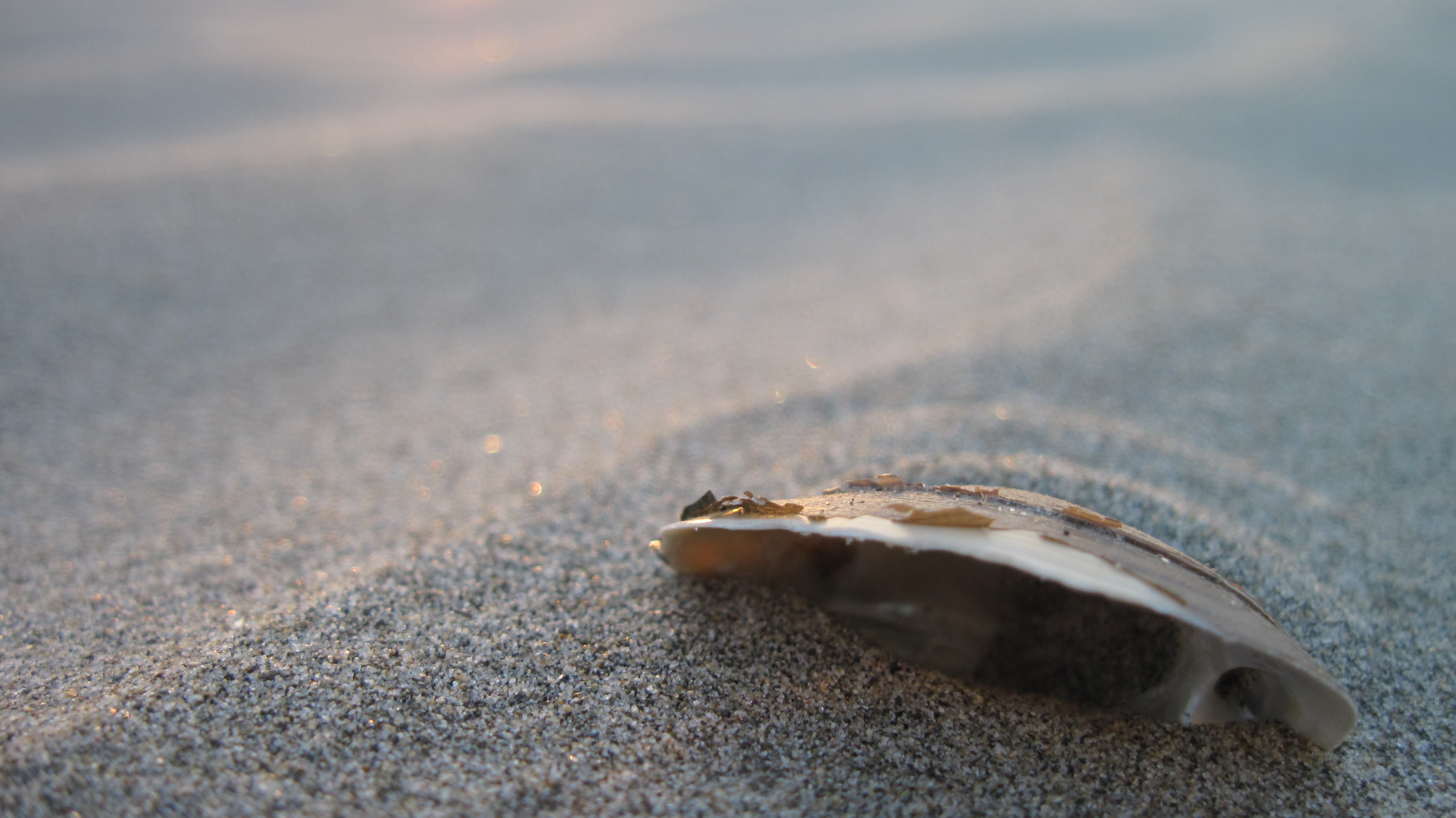
I kept my eyes focused on the ground, falling behind the rest as I stooped to pick up two halves of a clam shell in the sand. I had forgotten that shells could be found in the riverbed. I suppose having only seen them in the ocean before, I didn’t expect them here. With the shells in my pocket, I continued along, keeping an eye out for more. Before long I found another, bending to pick it up from the sand. It was small, and as I ran my fingers across its surface, the outside of the shell flaked like old paint on a wall. It wasn’t nearly as big as the others and, with its peeling surface, I was just about to toss it back down into the sand when I stopped myself. I ran my thumb over its rippled flaking surface again. It was so imperfect — so perfectly imperfect.

Sure, it wasn’t large, or very smooth. It was small and simple. It had its imperfections. It wasn’t the picture-perfect shell I had been looking for, but that didn’t make it worthless. Did I really want a flawless, picturesque shell anyway? In some ways it was the fact that the imperfections existed that made it valuable. It was real. It was raw.

My experiences, my home, my life — have all been like that shell. They came with aspects that weren’t always perfect or pretty. They came with imperfections. Is Pakistan a bed of roses or the first choice for luxurious living? No, but I love it. It’s beautiful. That shell is beautiful too, with its patterned exterior peeling and chipping away. It’s beautiful, imperfections and all.

There was only one shell that came home with me in the end. I left the others to keep the smallest one. Now it sits in a little clay dish on my desk in my room as a reminder. Something doesn’t need to be perfect in life for it to be valuable. In fact, it rarely is. Life, experiences, places and people all come with issues and disappointments. Make the best of the them, because there’s beauty in the imperfections.

IMG_1978